
We help you settle your claim & rebuild after a natural disaster
Coming Soon!
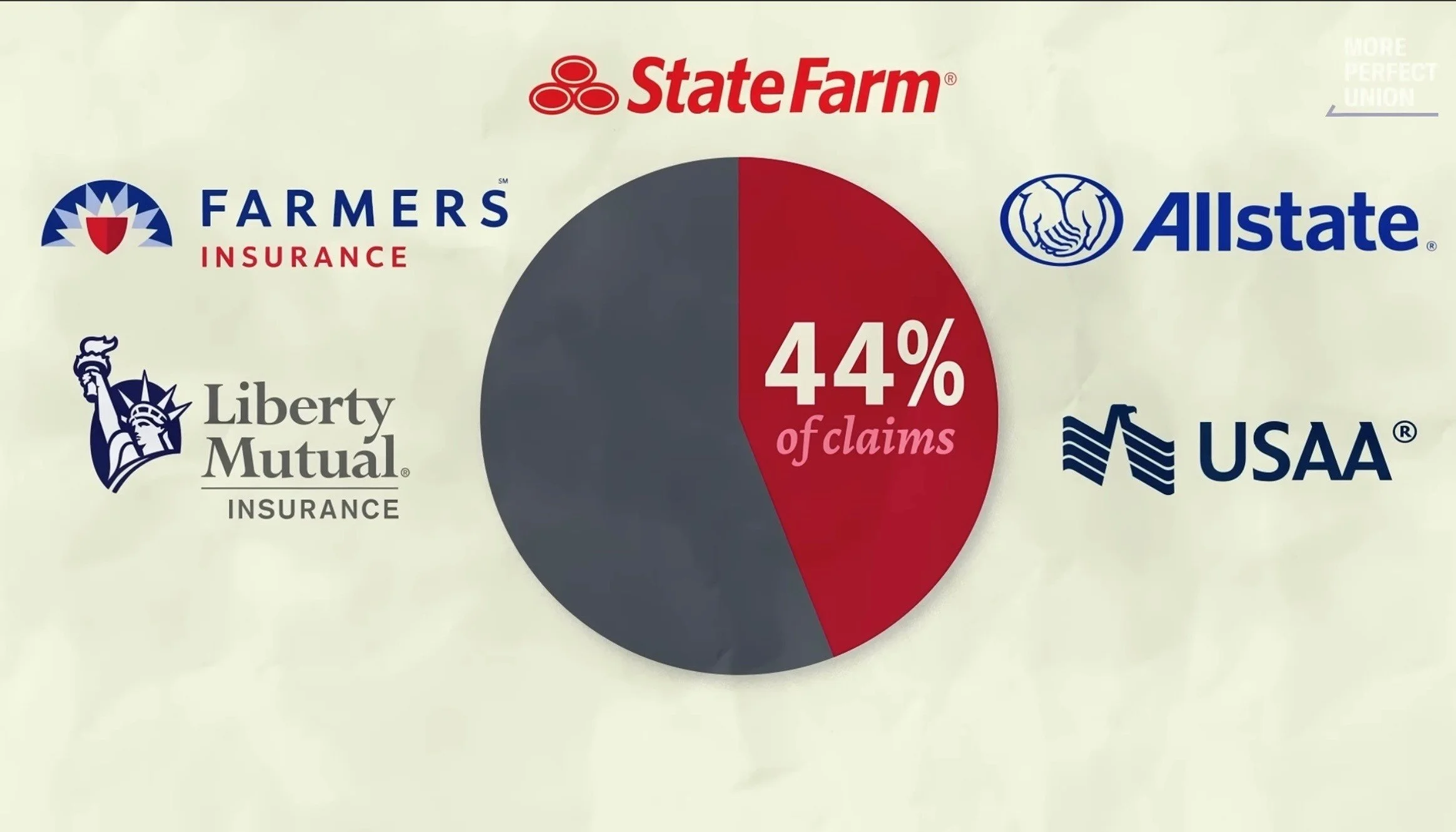
In 2025, the five (5) biggest home insurance companies did not pay out on 44% of claims resolved
(Ref: More Perfect Union)
Don’t give your insurance company the opportunity to Delay or Deny your valid claim.
We bring all the stakeholders together and share information to settle your claim and help you rebuild.
Our centralized, vetted nationwide network of recovery professionals—acting as a single point of coordination for Local, State & Federal resources—provides a number of advantages to victims of natural disasters.
1. Protection Against Exploitation & Fraud ("Feeding Frenzy")
Disaster zones are notoriously targeted by predatory actors, unlicensed contractors, and ambulance-chasing adjusters and legal entities.
Elimination of Predatory Solicitations: Homeowners and business owners are shielded from aggressive, unvetted cold calls, door-to-door scams, and high-pressure contract signing while in acute distress.
Vetted Credentialing: We enforce uniform standards, ensuring all participating contractors, engineers, and attorneys are licensed, insured, and verified, protecting victims from financial ruin and sub-standard repairs.
Fraud Mitigation: By acting as a secure clearinghouse for claims, permits, and financial disbursements, we create a digital audit trail that deters price gouging and fraudulent insurance or FEMA claims.
2. Operational & Administrative Efficiency
Post-disaster bureaucracy often stalls recovery due to fragmented communication between municipal, state, federal, and community organizations.
Coordinated Government Relief: Local and state agencies gain a unified dashboard to track resources, infrastructural damage, and workforce deployment without being overwhelmed by ad-hoc inquiries.
Streamlined Permitting: Integrating local jurisdictions and architectural/engineering firms allows for expedited, pre-vetted plan reviews and standardized fast-track permitting for rebuilding.
Optimized Supply Chain Logistics: Building supply companies can coordinate bulk resource distribution through the network rather than dealing with scattered, chaotic retail demands, preventing localized material shortages and hyper-inflation of supply costs.
3. Financial & Economic Acceleration
Transparent Claims and Financing: Bringing insurance claims adjusters and financial institutions into an organized workflow accelerates payout timelines. Homeowners receive structured guidance on bridging the gap between insurance settlements, loans, and FEMA grants.
Accountable Contracting: Contractors and custom home builders operate under standardized scopes of work and fair-pricing guidelines established within the network, reducing disputes, mechanics' liens, and abandoned projects.
How we help you Settle your Claim
& Rebuild
A FREE service to victims of natural disasters

Meet your Reconstruction/Restoration Advisor
File and Review your Insurance Claim
Connect with Local, State, & Federal Resources for Financial Assistance
Connect with Architectural and Engineering Firm(s) to plan your design
Review original loss estimate and all revisions on your insurance claim
Initiate, Review and Customize your Reconstruction/Restoration Plan
Review, Select and Submit Plan(s) to Local Jurisdiction
Connect with Attorneys to Litigate and Settle your Insurance Claim
Connect with Lending Institutions to Fund Construction
Connect with qualified Contractors & Custom Builders
Review, Compare & Select Contactor / Custom Builder
Review, Compare & Select Building Material(s)
Monitor & Report on Reconstruction/Restoration Project
Review & Approve Invoices for Payment
Final Review & Completion of Reconstruction/Restoration Project
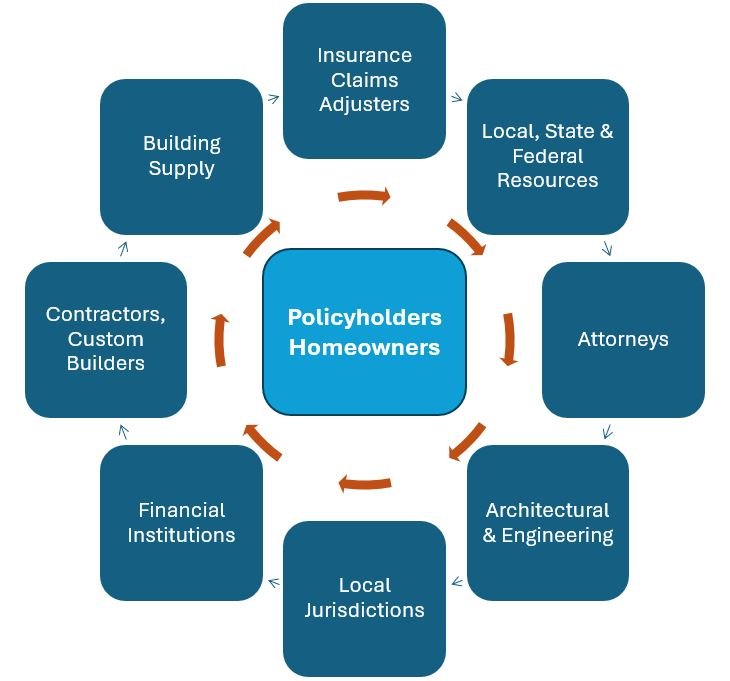
Policyholders | Victims of Natural Disasters
We offer a FREE service to the individuals, families, and commercial entities seeking assistance from our Stakeholder network to settle claims and rebuild homes and businesses after a natural disaster.
Stakeholder Network
Architect and Engineering
Role: Establish the foundational safety and structural viability of properties.
Interaction: Ensure all designs comply with building codes and risk thresholds.
Contractors
Role: The boots-on-the-ground execution team building or repairing the physical property.
Interaction: Translate architectural plans into reality and act as primary builders/remediators.
Building Supply Companies
Role: Material providers supplying the lumber, concrete, roofing, and safety equipment.
Interaction: Provide the essential physical inventory required for construction and repairs.
Local Jurisdictions
Role: City and county municipalities governing zoning, land use, and building safety.
Interaction: Issue building permits and mandate adherence to municipal codes and safety regulations.
Financial Institutions
Role: Banks and mortgage lenders providing the capital and loans for property ownership.
Interaction: Require policyholders to maintain specific insurance coverages to protect their financial stake in the property.
Attorneys
Role: Legal representatives specializing in real estate, contract law, or insurance disputes.
Interaction: Help policyholders interpret complex contracts, navigate liability issues, or litigate claims.
Insurance Claims Adjusters
Role: Interviews the policyholder, inspects damage to measure the loss, checks the policy to see what limits and rules apply.
Interaction: Collaborates with stakeholders to negotiate a fair and final payout amount and closes the file.
Local, State, Federal Emergency Management Agency (FEMA)
Role: The federal authority managing disaster response, mitigation, and the National Flood Insurance Program (NFIP).
Interaction: Provide emergency relief, establish flood mapping, and offer subsidized insurance for properties in high-risk zones.
Our Partners

A unified ecosystem dramatically lowers administrative costs and decreases structural cycle times.
Streamlined claim-to-permit tracking: Real-time visibility into local permitting statuses prevents fraudulent delays and justifies extended Loss of Use payouts.
Minimized supplemental requests: Direct mapping between Xactimate line-item valuations and material orders on mybldr.com guarantees pricing alignment and reduces carrier disputes.
Faster file closure: Automated workflows accelerate data handoffs, allowing adjusters to move from damage assessment to closed claims significantly faster.

Lenders significantly lower their underwriting risks for both temporary construction loans and permanent mortgages.
Mitigated mechanics lien risks: Automated cross-checks between material deliveries, permit sign-offs, and payouts prevent unbacked project liabilities.
Validated collateral valuation: Merging certified Xactimate estimates with municipal permits guarantees that the rebuilt home matches or exceeds its appraised asset value.
Streamlined draw inspections: Digital verification of permitted milestones through PermitFlow automates and secures the construction loan draw process.

Builders can maximize project execution capacity while eliminating the administrative overhead of rebuilding zones.
Instant, executable project pipelines: The mybldr.com platform instantly matches pre-vetted contractors with ready-to-build policyholders.
Automated compliance paperwork: PermitFlow completely manages the bureaucratic process of municipal applications, allowing crews to focus entirely on building.
Guaranteed, low-risk cash flow: Linking bank escrow disbursements to pre-approved Xactimate benchmarks ensures steady, dispute-free payments.

Agencies like FEMA or state-level emergency offices gain transparent, auditable regional recovery frameworks.
Auditable fund allocation: Complete end-to-end data transparency protects public recovery grants and relief funds from contractor fraud.
Macroscopic progress monitoring: Aggregated metadata gives regional coordinators a real-time, data-driven look at community recovery velocities.
Enforced community resilience: Coupling automated permit checks with modern building code verification helps ensure that communities are rebuilt to higher, disaster-resilient standards

Suppliers secure hyper-localized, highly predictable demand forecasts during chaotic post-disaster periods.
Direct BOM integration: Project blueprints uploaded to mybldr.com instantly generate exact, executable Bills of Materials (BOM) for localized ordering.
Optimized inventory staging: Visibility into local permit pipelines via PermitFlow allows distributors to pre-stage high-demand materials before ground break.
Secure automated transactions: Integration with construction escrow accounts ensures immediate B2B vendor payments upon material delivery verification.

The core value proposition for attorneys using MyRebuild services is a streamlined, indisputable pathway to full indemnification. By combining Xactimate (industry-standard estimating), PermitFlow (pre-construction/permitting), and mybldr.com (materials/project management), attorneys can bypass insurer lowball tactics, eliminate post-disaster rebuild bottlenecks, and secure definitive, legally bulletproof settlements for policyholders.
1. Xactimate: Leveling the Legal Playing Field
Evidence-Based Negotiations: Because the majority of insurers use Xactimate to underpay or under-scope claims, attorneys can use the same software to demand native .ESX files in discovery.
Accurate Market Alignment: It allows attorneys to pinpoint discrepancies between lowball carrier payouts and actual localized construction costs.
Defensible Valuations: Provides a standardized, itemized framework making it easier to present damages to judges, mediators, or expert witnesses.
2. PermitFlow: Eliminating Bureaucratic Delays
Automated Compliance: Automates jurisdiction-specific zoning requirements and building codes, avoiding costly manual research.
Accelerated Timelines: Cuts municipal review times in half by preparing error-free, requirement-ready applications.
Predictability: Helps attorneys provide policyholders with an exact timeline for when actual construction can commence, mitigating additional living expense (ALE) disputes.
3. mybldr.com: Centralizing the "Source of Truth"
Supply Chain Efficiency: Integrates directly with Builders FirstSource to manage material ordering, supply chain tracking, and real-time bids.
Budget Tracking: Allows attorneys, builders, and the client to share a transparent, centralized record of all rebuild costs.
Risk Reduction: Transforms 2D blueprints into 3D models, drastically reducing change orders and keeping the rebuild within the confines of the insurance settlement.
The Synergistic Advantage
If you prioritize expeditious settlements and evidence-based advocacy, this integrated tech stack transitions an attorney's role from a simple claims negotiator to a full-service recovery advocate. You gain the ability to accurately define the true cost to rebuild (Xactimate), get the project legally cleared (PermitFlow), and physically execute the build without material delays or budget creep (mybldr.com). This provides undeniable proof that the policyholder was completely made whole.

Design teams reduce iterative revision cycles by working within predefined regulatory and financial boundaries from day one.
Design-to-budget alignment: Access to localized Xactimate cost databases prevents architects from drafting structures that exceed insurance payouts.
Rapid code-compliance loops: PermitFlow provides real-time zoning and municipal code feedback, minimizing structural design revisions.
BIM-to-marketplace handoffs: Seamlessly exporting digital models into mybldr.com accelerates the transition from engineering to physical procurement.

Municipalities gain the administrative bandwidth required to manage the massive influx of post-disaster applications.
Pre-vetted, compliant data packages: PermitFlow standardizes applications to match specific regional building codes, drastically reducing municipal kickback rates.
Transparent valuation verification: Building departments can instantly verify structural valuations using standardized Xactimate reports, fast-tracking plan checks.
Workload mitigation: Shifting applicant intake, tracking, and basic compliance checks to automated platforms reduces the burden on local code enforcement staff.
Initiate Your Project Consultation
Submit this form to speak with a Reconstruction Specialist to formulate a tailored proposal.